Wednesday, May 10, 2017

Poland Day 11 - Science and Solidarity

So apparently yesterday's blog entry was not wholly accurate with respect to the oldest cathedral in Poland. Our first stop today was the town of Gniezno which also claims to be the home of oldest Cathedral in the country. The Royal Gniezno Cathedral has apparently been around since the year 975 and was the coronation place of several of Poland's earliest monarchs.


Regardless of its age, it's an impressive church. Especially the bronze doors with a beautiful depiction      of the martyr, Saint Adalbert of Prague.


The birthplace of the nation also comes into question as Gniezno (loosely translates to "the nest"), also lays claim to that piece of history. When I questioned our tour director on this he agreed there is still debate on the exact location of the country's earliest roots however it is generally accepted the lands between Poznan and Gniezno show the earliest signs of Poland as a nation.


Next stop is the town of Torun, the birth place of Nicolaus Copernicus in 1473. The photo below shows the home he grew up in and the following shot shows the church he was baptized in.


Today was horribly cold and wet, so after our tour of the old town, a few of us bolt for a nearby restaurant.


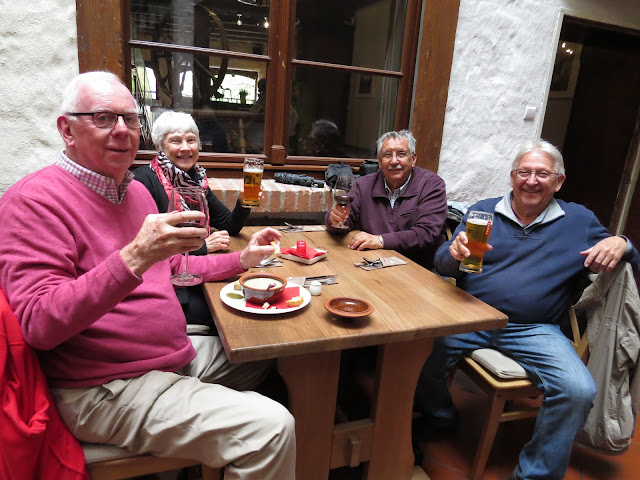
Now warm and dry, we settle in for a beverage and a nice meal.  Mike, a fellow Canadian on the tour joins us. Mike is from Calgary.


The drive from Torun to Gdansk has us checking in to our hotel around 5:15. Of course Gdansk is the home of Lech Walesa  and the Solidarity movement, which resulted in Poland regaining democratic independence in 1989.

The view from my room is over local rooftops toward the city's Panoramic Ferris Wheel.


The view also reveals some decorative downspouts 


It's still cold and wet here in Gdansk, so it's a quick tour of nearby dining establishments, a warm meal and back to the hotel for some much needed down time and sleep. We'll spend the whole day tomorrow touring this city before we head to our final destination, Warsaw, on Friday.


Tuesday, May 9, 2017

Poland Day 10 - Fighting Goats and Beer

Today we're in Poznan, a city of about 550,000 people. This city is thought to be the birthplace of Poland and is home to the country's oldest cathedral, originally built in the 10th century. It's been rebuilt several times, mostly due to fire. The last rebuild came in 1945 after a fire which occurred during the city's liberation from the Germans. 


The city's centre square is full of restaurants, cafes, shops and bakeries.


The story of the fighting goats goes something like this. A local cook was preparing a meal for a large group and was about to slaughter 2 goats for that purpose. Unfortunately for him, the goats escaped and took refuge in the town hall where they were seen to butt heads regularly.

Now, every day at noon, the goats make an appearance from the clock tower to put on a display of their head butt fights. If I could figure out how to get video to work here, you could see a shaky showing of the event. But for now suffice it to say, the display had the kids in the gathered crowd laughing.


 After a brief walking tour and lunch in the old town square, it was off for a tour of Lech brewery.
Lech Premium happened to be the first "piwo" we enjoyed after arriving in Kielce. (see day 1).
Apparently the copper covering these mash pots is just that, a covering. It's just there for show now as stainless steel is the current standard in brewing.


The bottle washing, filling and packaging system was pretty impressive, capable of a 60,000 bpm output.


Some of the group enjoying a beverage after the tour.


Tomorrow...  Gdansk.

Monday, May 8, 2017

Poland Day 9 - Shock and Awe and Little People

5 o'clock came early this morning (well that's a redundant statement, isn't it), with our wakeup calls to start the next leg of our journey to the town of Oswiecim.  That is the town that during WWII, came to be known by it's now infamous name, Auschwitz.
I learned a few things today.

  First I learned that despite having seen many photos, books, movies and documentaries on the topic,  I wasn't quite prepared for the scale of the camps we toured.
  I also learned that Auschwitz was actually a series of camps, with Auschwitz II, more famously known as Birkenau located about 3 kilometres down the road near the village of Brzezinka. Auschwitz was the original housing up to 15,000 prisoners. But Birkenau was the largest, housing anywhere between 80,000 and 120,000 prisoners at any one time.
 
There was far too much information provided to even begin to paraphrase here. And there were a couple of displays that although not terrible to see, just seemed a little too personal for me to  photograph. Piles of personal belongings, shoes and hair, which were all destined to be reused for "the cause".

The first five photos are the original Auschwitz, which had previously been a Polish army barracks, minus the barbed wire and second stories on the barracks (which the prisoners built), when the Germans took over. This camp is mostly intact.


A view from outside the wire at Birkenau. The majority of buildings here were demolished by the Germans as the Russians approached to liberate the area. This camp must have covered at least ten times the area of the original.


A view of the track and arrival platform, inside the wire at Birkenau.


Remnants of the barracks.


Guard houses every 150 yards.


Although a difficult subject, it's obvious the Poles see the importance of ensuring this story does not get lost in time. I was glad to see group after group after group of teenagers touring and I'm sure getting an up close lesson in a horrific time in Polish and human history.


Meanwhile in Wroclaw...  We checked in to our hotel around 4pm, then did a "walkabout" (lots of Aussies in the group). This first shot just made me think of Matthew and whether we could talk him into trading his Aprilia for this little beauty.


The building centred below is apparently one of very few that survived the war unscathed. 


Just a small portion of the rebuilt town square. Why don't we have town squares like this back home?


A shrine to the protein in our meals.


A few of the more than 350 Gnomes in Wroclaw Poland are pictured below. Originally a symbol of the "Orange Alternative" movement, a peaceful and satirical protest against the communist rule in the 1980's, now as likely as not to be advertising. Remember the moose project in Toronto? However these gnomes are only a foot or so tall.


Tomorrow it's off to Poznan, which is thought to be the birthplace of Poland in the 10th century.


Sunday, May 7, 2017

Poland Day 8 - Rain in the Tatras Mountains

Today we visit the Resort town of Zakopane in the Tatras mountain range.
It's a well known Polish ski area where John Paul II skied as a young man.
Mostly sight seeing today learning about the old "highlander" culture and traditions.

Shown below is a popular church in the mountain ski area. btw... if you didn't already know, Poland is somewhere around 90 to 95 percent Catholic.


The next 2 photos are of a local smoke house where a tasty smoked sheep milk cheese is produced. Apparently it's a specialty of this area.


This shows the smoke blackened rafters of the smokehouse and a number of cheese... not sure what to call the light coloured, almost shell shaped objects in this photo...  but anyway, that's the cheese being cured. Note the Crucifix in the photo. Like I said, this land is very Catholic.


The highland farmhouse adjacent to the smoke house. I thought the decorative old farm implements were great.


After lunch and between rain showers, we were able to go on a nice horse drawn wagon ride.


When heading back to our hotel, we stopped to visit a relatively new church in town. It was built after Pope John Paul II, recovered from the gunshot wounds he received in the 1981 assassination attempt. The story goes that being such a regular in this ski village, when news of his injuries reached the locals, they prayed earnestly for his recovery and promised to build a church in his honour if he recovered.  


One of the stained glass windows in the church actually depicts the attempt, showing him slumping and being attended to in his limo and the shooter holding a gun, in the pane second from the bottom left. The pane at top middle, apparently depicts a guard with an uzi.


The next two shots were taken from my hotel room balcony. Nice spot and nice day, despite the crummy weather. 


Tomorrow has us up at 5:00am and on the road by 6:30 to keep our tour reservation at Auschwitz. 
That will be a somber tour, but I think something we need to see while here.

Saturday, May 6, 2017

Poland Day 7 - Don't pass the salt

It was a 6am wakeup today for an early breakfast and an early appointment with the Wieliczka Salt mine, a Unesco World Heritage Site. It's about a 30 minute drive from Krakow and well worth the early start to the day.

I've seen photos of this place online, but that doesn't compare to seeing it up close and personal.
Commercial mining here ceased in 1996 after over 700 years of operation. The mine was also used during the war by the Germans as a hidden manufacturing facility. But the legacy of a few very artistic miners lives on, 400 feet or more underground.

The mine now serves as a tourist attraction (over 1.5 million people visited last year), as well as a health spa (apparently breathing salt air is good for asthmatic or otherwise damaged lungs), and a banquet and conference facility.

But the main attraction is the carvings including a stunning cathedral area, all carved in rock salt.
Even the crystals in the chandeliers are salt.


Some incredible carving!


Obviously the salt carving tradition has carried on. No, not me...  it's Pope John Paul II behind me.


Just a couple of the many carvings as you traverse the mine.


Apparently back in the day, once horses or mules were sent down the mine, they spent the rest of their lives there. Partly because their eyes would adapt to the darkness of the mine and they wouldn't be able to take returning into the sunlight.

If I recall properly, there are over 150 miles of shafts in this mine.


A banquet centre, carved in salt 400+ feet underground.


 Back in Krakow, we toured the Cathedral where Bishop Karol Wojtyla presided (aka John Paul II) and the kings castle which during WWII was occupied by the German leader Hans Frank. See the gold dome in the shot below. We were told it's capped with over 40 kilograms of gold. What's gold trading at per ounce right now???


For anyone who saw the movie Schindler's List, this is Oscar Schindler's factory in the photo below. It's obviously been updated since the war and now stands as a museum focused on life in Krakow, including the atrocities during the war.


A symbol of evil.


Oscar Schindler's office.


The stone structure in the shot below is the memorial to the Plaszow concentration camp which stood on this site. We are told this large parcel of land on the outskirts of Krakow will never be used again.


Another early morning tomorrow, as we head to the resort town of Zakopane at the base of the Tatras mountains.